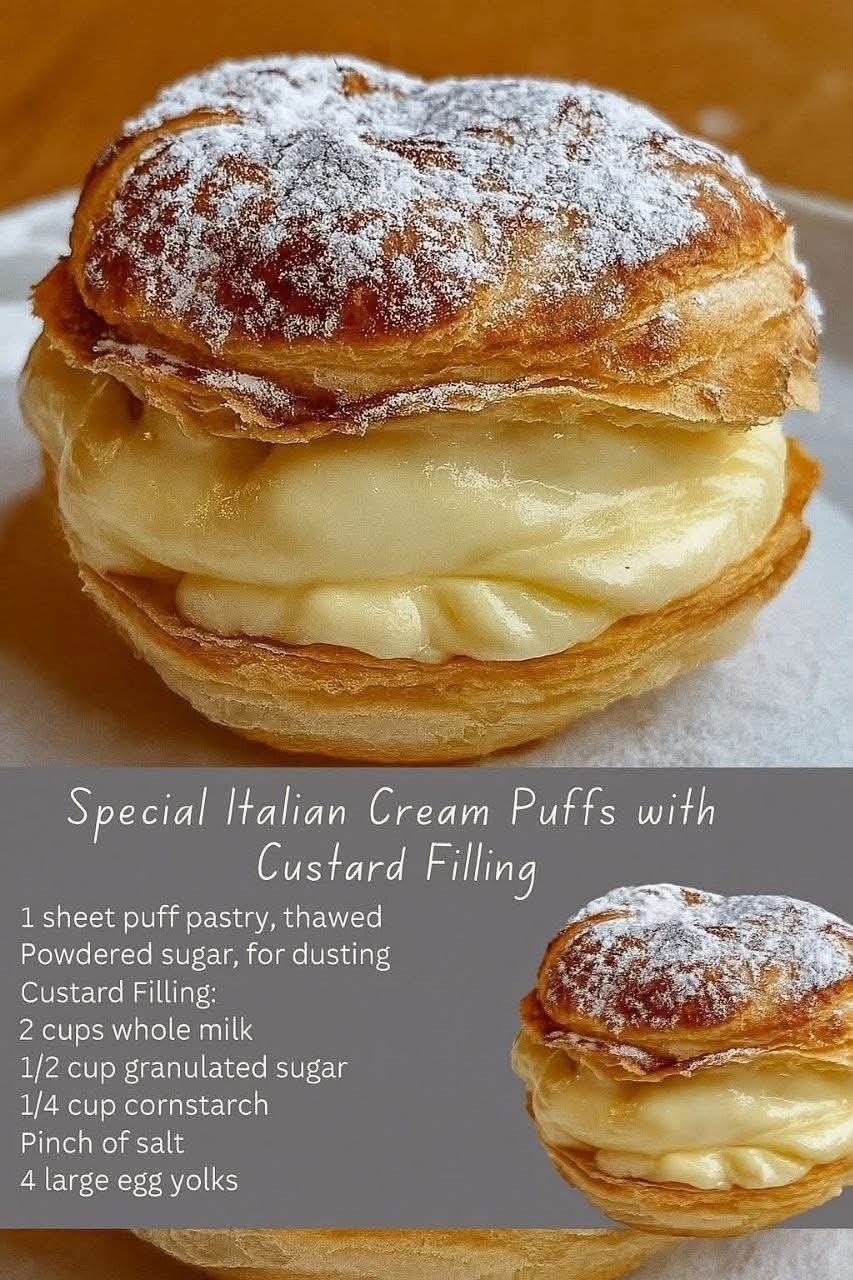

IntroductionThere’s something undeniably enchanting about Italian pastries. From the delicate cannoli to the vibrant fruit tarts, they speak of tradition, craftsmanship, and an unwavering dedication to sweet perfection. Today, we’re diving into a treat that embodies all of these qualities, yet manages to be surprisingly approachable for the home baker: Special Italian Cream Puffs with Custard Filling. Imagine a cloud-light, flaky pastry shell, crisp and golden, giving way to a rich, velvety custard that melts in your mouth. Dusted generously with a veil of powdered sugar, these cream puffs are not just a dessert; they’re an experience, a little bite of Italian heaven that promises to impress.Our inspiration for these “Italian” cream puffs comes from the beloved *bignè* or *pasticcini* often found in Italian bakeries, but with a clever twist to make them accessible and stress-free. While traditional *bignè* are made with choux pastry, our special version utilizes readily available puff pastry. This ingenious shortcut means you can achieve that spectacular flaky texture with minimal effort, allowing you to focus your culinary energy on crafting the star of the show: the exquisite custard filling. This recipe is designed to deliver maximum impact with relative ease, proving that you don’t need to be a professional pastry chef to create something truly spectacular.Whether you’re looking for an elegant dessert to grace your dinner party table, a delightful treat for an afternoon coffee, or simply a way to indulge your sweet tooth, these Special Italian Cream Puffs are the answer. They offer a beautiful balance of textures and flavors – the crispness of the pastry, the luxurious creaminess of the custard, and the subtle sweetness of the powdered sugar. Get ready to embark on a sweet journey that will transport your taste buds straight to the sun-drenched patisseries of Italy, all from the comfort of your own kitchen.Nutritional InformationPer serving (approximate values):Calories: 350Protein: 7gCarbohydrates: 40gFat: 18gFiber: 1gSodium: 150mgIngredients1 sheet puff pastry, thawedPowdered sugar, for dusting2 cups whole milk1/2 cup granulated sugar1/4 cup cornstarchPinch of salt4 large egg yolks1 teaspoon vanilla extract (optional, but recommended)2 tablespoons unsalted butter (optional, for richer custard)InstructionsPrepare the Custard Filling: In a medium saucepan, whisk together the granulated sugar, cornstarch, and pinch of salt until well combined.In a separate bowl, whisk the egg yolks until smooth.Gradually whisk in about 1/2 cup of the whole milk into the egg yolks to temper them. This prevents the yolks from scrambling when added to the hot milk.Pour the remaining 1 1/2 cups of whole milk into the saucepan with the sugar mixture. Heat over medium heat, stirring constantly, until the mixture is warm and steaming, but not boiling.Slowly pour the tempered egg yolk mixture into the warm milk in the saucepan, whisking continuously.Continue to cook over medium heat, whisking constantly and scraping the bottom and sides of the pan, until the custard thickens significantly and comes to a gentle boil. It should be thick enough to coat the back of a spoon. This typically takes 5-8 minutes after adding the yolks.Once thickened, remove the saucepan from the heat. If using, stir in the vanilla extract and unsalted butter until melted and fully incorporated.Strain the custard through a fine-mesh sieve into a clean bowl. This step ensures a perfectly smooth, lump-free custard.Press a piece of plastic wrap directly onto the surface of the custard to prevent a skin from forming.Refrigerate the custard for at least 2-4 hours, or preferably overnight, until thoroughly chilled and set.Prepare the Puff Pastry: Preheat your oven to 400°F (200°C). Line a baking sheet with parchment paper.Unroll the thawed puff pastry sheet onto a lightly floured surface. Using a round cookie cutter (about 2-3 inches in diameter) or a knife, cut out circles or squares of puff pastry. You should get about 12-16 pieces depending on the size.Carefully transfer the pastry shapes to the prepared baking sheet, leaving some space between them.Prick each pastry piece several times with a fork. This helps prevent them from puffing up too much in the center, creating a better base for the custard.Bake for 12-18 minutes, or until the puff pastry is golden brown, puffed, and crisp. Baking time may vary depending on your oven and the thickness of your pastry.Remove the baked puff pastry from the oven and transfer them to a wire rack to cool completely. They must be completely cool before filling to avoid making them soggy.Assemble the Cream Puffs: Once the custard is thoroughly chilled and the puff pastry shells are completely cool, it’s time to assemble.If the custard is very stiff, give it a quick whisk to loosen it slightly, but do not overmix. For best results, transfer the chilled custard to a piping bag fitted with a round or star tip.Carefully slice each cooled puff pastry piece horizontally in half, creating a top and a bottom.Pipe or spoon a generous dollop of the chilled custard onto the bottom half of each puff pastry.Gently place the top half of the puff pastry over the custard, creating a sandwich.Arrange the assembled cream puffs on a serving platter.Just before serving, dust generously with powdered sugar using a fine-mesh sieve.Serve immediately and enjoy your Special Italian Cream Puffs with Custard Filling!Cooking Tips and VariationsAchieving perfect Italian cream puffs relies on a few key techniques and a little patience. For the puff pastry, ensure it is properly thawed but still cold when you work with it. If it gets too warm, the butter will melt, and you’ll lose that characteristic flakiness. Handle it minimally to keep it cold. When baking, don’t open the oven door too often, as this can cause the pastry to deflate. The pricking step is crucial for creating a flatter, more stable base for your custard. If you want a more dramatic puff, you can omit pricking half of them and compare the results.The custard is the heart of this dessert, so pay close attention to its preparation. Continuous whisking is your best friend when making pastry cream; it prevents lumps and ensures even cooking. Don’t be afraid to cook it until it’s quite thick, as it will thin out slightly when cooled and whisked. Straining the custard through a fine-mesh sieve is a non-negotiable step if you want a silky-smooth texture. Even if you think there are no lumps, you’ll often be surprised by what the sieve catches. For an extra rich custard, consider adding a tablespoon or two of unsalted butter at the end, just after removing it from the heat. This adds a lovely gloss and depth of flavor. Always make sure the custard is completely chilled before using it; warm custard will make your pastry soggy.For flavor variations, the custard is a versatile canvas. You can infuse the milk with citrus zest (lemon or orange) while heating it, then strain it out before adding the egg yolks. A splash of a liqueur like Grand Marnier, Amaretto, or even rum can be added to the cooled custard for an adult twist. Almond extract can replace or complement vanilla for an almond-flavored cream puff. You could also swirl in a spoonful of melted chocolate or espresso powder into a portion of the cooled custard for a mocha or chocolate variation. For a different texture, you can fold a small amount of freshly whipped cream into the cooled custard just before filling, making it lighter and airier, though it will be less stable for long periods. Finally, for presentation, a sprinkle of finely chopped pistachios or a few fresh berries (raspberries or blueberries work wonderfully) can add a pop of color and freshness.Storage and ReheatingThese Special Italian Cream Puffs with Custard Filling are truly at their best when served fresh, ideally within a few hours of assembly. The crispness of the puff pastry is paramount to the overall experience, and unfortunately, it will begin to soften once it comes into contact with the moist custard. However, if you have leftovers or need to prepare components in advance, there are effective ways to manage storage.The custard filling can be made up to 2-3 days in advance. Store it in an airtight container in the refrigerator, with plastic wrap pressed directly onto the surface to prevent a skin from forming. When you’re ready to use it, give it a quick whisk to restore its smooth consistency. The baked puff pastry shells can also be prepared a day in advance. Once completely cooled, store them in an airtight container at room temperature. To restore some of their crispness, you can briefly reheat them in a preheated oven at 300°F (150°C) for 5-7 minutes just before assembly, then let them cool again.Once assembled, cream puffs should be stored in an airtight container in the refrigerator. They will remain edible for up to 1-2 days, but be aware that the pastry will gradually soften. They are not suitable for freezing once assembled, as the custard’s texture will change upon thawing, and the pastry will become very soggy. There is no effective way to “reheat” assembled cream puffs without compromising the texture of both the pastry and the custard. It’s best to enjoy them chilled or at room temperature, knowing that the pastry will be softer than when freshly baked. For the best experience, assemble them as close to serving time as possible.Frequently Asked QuestionsCan I make these cream puffs gluten-free?Yes, you can adapt this recipe to be gluten-free. The main component to address is the puff pastry. Look for a high-quality gluten-free puff pastry available in many grocery stores. The custard filling is naturally gluten-free as long as you use cornstarch (which is gluten-free) as the thickener. Ensure all your other ingredients are certified gluten-free if you are strictly avoiding gluten.My custard has lumps. What went wrong and how can I fix it?Lumps in custard usually occur if the egg yolks weren’t tempered properly, if the mixture wasn’t whisked continuously, or if it cooked too quickly. If you have lumps, don’t despair! The best way to fix it is to strain the warm custard through a fine-mesh sieve immediately after cooking. If it’s already cooled and very lumpy, you can try whisking it vigorously or even blending it with an immersion blender for a very short burst, but be careful not to over-blend, which can make it too thin. Straining is generally the most effective method.Can I use a different type of milk for the custard?While whole milk is highly recommended for the richest, creamiest custard, you can experiment with other types of milk. 2% milk will work but might result in a slightly less decadent texture. Skim milk is generally not recommended as it will yield a much thinner, less flavorful custard. Non-dairy milks like almond milk or oat milk can be used, but be aware that they may alter the flavor and consistency of the custard slightly. You might need to adjust the amount of cornstarch or add a bit more fat (like butter or a non-dairy butter alternative) to achieve a similar richness.Why did my puff pastry not puff up properly?Several factors can prevent puff pastry from rising. The most common reasons include the pastry getting too warm before baking (causing the butter to melt out), not baking at a high enough temperature, or handling the pastry too much. Make sure your oven is preheated to the correct temperature, and work quickly with cold pastry. If you’re using a store-bought puff pastry, ensure it hasn’t expired and has been stored correctly. Over-pricking the pastry can also inhibit puffing, though for this recipe, a slight pricking is intentional to create a flatter surface for filling.
Special Italian Cream Puffs with Custard Filling